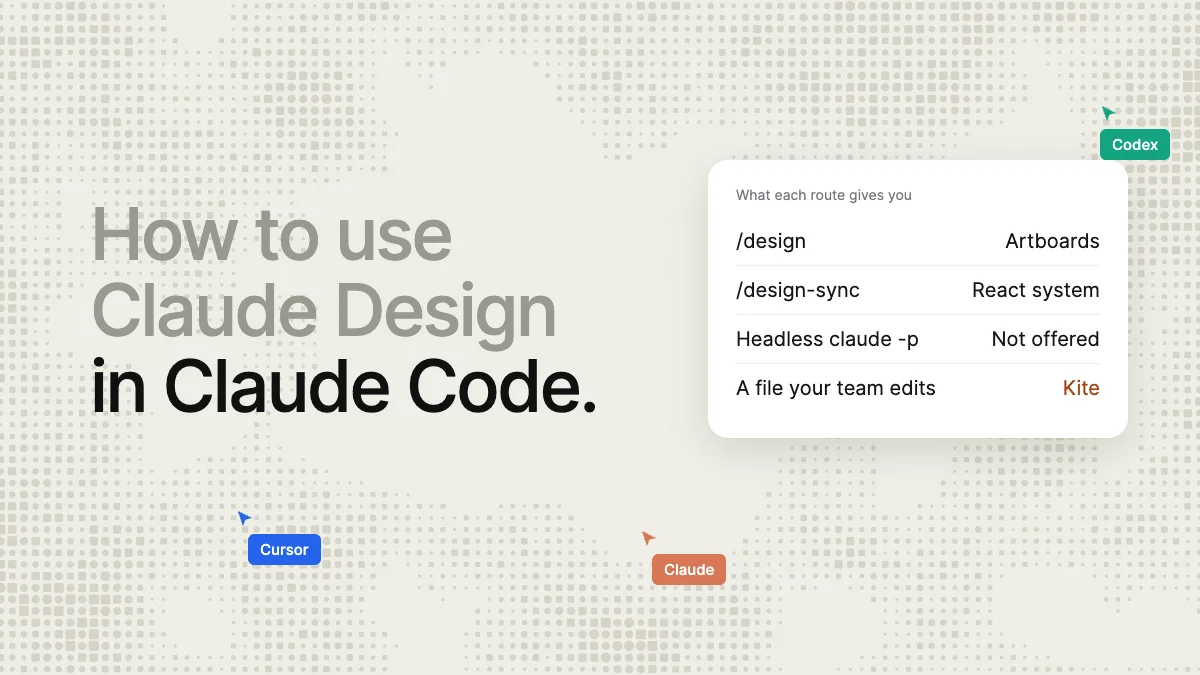
Short answer: Claude Design now runs inside Claude Code. In an interactive session, in the terminal or the Claude desktop app, type /design and a brief, such as /design a settings screen for a mobile banking app. Claude draws artboards on one canvas, publishes it as a Claude Design artifact and gives you the link, where you edit it in a desktop browser, and /design-sync uploads your React design system. You need Claude Code v2.1.265 or later, a claude.ai sign-in and a Pro plan or higher, and it does not run in headless claude -p runs: we tried.
Key takeaways
- Claude Design moved into Claude on September 16, 2026; the separate site at claude.ai/design closes on December 14, 2026.
/designdrafts artboards and publishes them as an artifact on claude.ai; it needs Claude Code v2.1.265 or later and a paid plan./design-syncconverts a React design system from your repository, but still uploads to the standalone site that closes on December 14.- In a
claude -prun, Claude Code had no artifact tool:/designonly offered to manage access, and a plain request came back as text. - The handoff to code stays in Claude Code: the session that made a design can build it, or you paste a design's link into Claude Code in your repository.
Every fact about Anthropic below was read on November 20, 2026 on its own pages: the Claude Design product page, its help center, the Claude Code command list, the artifacts docs and the changelog. We ran Claude Code the same day; Kite publishes this page and is a design tool your agent can use, introduced at the end. For what closes on December 14, see is Claude Design shutting down?
What changed, and when
Claude Design started as a separate site and has become part of Claude. Anthropic's product page now says: “You can now use Claude Design in any conversation with Claude, including in Claude Code and the Artifacts tab, with Claude Tag coming soon. All of its features, including on-canvas editing, come with it”. The dates, each from Anthropic's own pages:
- April 17, 2026: Claude Design launches as an Anthropic Labs product (release notes). The launch post already promised a “handoff bundle that you can pass to Claude Code with a single instruction”.
- August 17–21, 2026:
/designarrives in Claude Code as a research preview. Anthropic's weekly notes say it “brings Claude Design's artboard workflow into the CLI and Claude Code Desktop, built on artifacts”, at the time for Pro, Max, Team and Enterprise. - September 16, 2026: “You can now ask for a design, deck, or document in any conversation with Claude, including in Claude Code and the Artifacts tab” (release notes).
- October 16, 2026: the Claude Code changelog adds a notice to
/design-syncand/design-loginthat claude.ai/design closes by December 14. - November 3, 2026:
/design-syncnow says up front when your design system has moved to Claude, and stops. - November 17, 2026: a fix stops Claude reading design system token files that don't exist when it starts a design.
- December 14, 2026: the standalone site at claude.ai/design closes (moving guide), while Claude Design itself continues inside Claude.
How to use Claude Design in Claude Code
Anthropic's help center gives two ways in. You can “ask Claude to turn your idea into a design”, or “use /design to create, edit, and sync designs, on desktop or in the terminal”. Before either works, check these:
- A plan with Claude Code. Claude's pricing table marks Claude Code “No” on Free and “Yes” on Pro, Max, Ultra, Team and Enterprise. Pro is $20 a month, or $17 a month billed yearly.
- Claude Code v2.1.265 or later. Run
claude --version; Anthropic's install page says Homebrew and WinGet installs “do not auto-update”: runbrew upgrade claude-codeorwinget upgrade Anthropic.ClaudeCode. - A claude.ai sign-in. Run
/login, since the artifacts docs say sessions on “an API key, gateway token, or cloud-provider credential cannot publish”, and the command is unavailable on Amazon Bedrock, Google Cloud, Microsoft Foundry and Claude Platform on AWS. - The Design template on. On Team and Enterprise plans, the artifacts docs say to “ask an Owner to turn the template on under Organization settings > Artifacts on claude.ai” if it's off. Organizations with customer-managed keys (CMEK), HIPAA or zero data retention don't get artifacts in Claude Code.
In the terminal (the CLI)
Start Claude Code in your project with claude, then type /design and what you want drawn. Anthropic's week 34 notes give this example: /design redesign the composer based on what people actually use it for. Claude prints a link to the published canvas, and your browser opens on it, where you select an element on an artboard and change it and your edits save on their own. Then “tell Claude which option to implement”.
In the Claude desktop app
Open Claude, sign in and click the Code tab. The app includes Claude Code, so you don't install the CLI, but “a paid subscription is required” (Anthropic's docs). Artifacts need app version 1.13576.0 or later, and then you type /design the same way.
Without the command
You can ask in plain words: “turn this idea into a design”. The Academy tutorial notes that inside your repository “Claude can read the code and pick up the colors, type and spacing your product already uses. This needs no setup”. For a polished web page rather than a canvas, Claude Code also applies a built-in design skill to any artifact it publishes. Anthropic's separate frontend-design skill does a similar job for the code it writes.
/design, /design-sync and the other commands
From Anthropic's command list, read November 20, 2026:
| Command | What it does | What it needs |
|---|---|---|
/design [brief] | Drafts “UI mockups, screen flows, landing pages, or posters as artboards on one canvas, published as a Claude Design artifact” | v2.1.265 or later, a session where artifacts are available, the Design template |
/design consent, /design revoke | Gives Claude access to Claude Design, or takes it back | You type it yourself when Claude asks |
/design-sync [hint] | Converts your repo's React design system and uploads it, so designs use your real components | /design-login; a first sync “can take a few hours on a large repo”; uploads to the site that closes December 14 |
/design-login | Signs in for /design-sync with your claude.ai account | For the standalone site, which closes by December 14, 2026 |
/slides [brief] | Makes a deck as a Claude Slides artifact; decks are a separate artifact, Claude Slides | Same as /design, with the Slides template |
/artifacts | Lists your artifacts, designs included, to attach one to the session or open it | A session where artifacts are available |
Anthropic describes /design more broadly elsewhere. The help center says it can “import a design into your codebase, export your code as a live prototype, or let Claude build the whole thing from start to finish”. The command list itself only describes the artboard canvas, so read the wider claims as things you ask Claude to do in the session.
We tried /design headless: what happened
On November 20, 2026 we ran Claude Code 2.1.327 with Claude Sonnet 5.5, headless (claude -p), in an empty folder. It was signed in to a paid claude.ai account, with no plugins, user settings or MCP servers. The brief: a sign-up screen for a mobile app for a neighbourhood running club.
| Run | Time | Tool calls | What came back |
|---|---|---|---|
1. /design a sign-up screen… | 3.0 s | 0 | “In this session, /design only manages agent access to Claude Design projects.” No canvas, no link, no file |
| 2. “Turn this idea into a design: …” | 15.2 s | 0 | A written spec in the terminal: layout, colours, states, accessibility, three open questions. No canvas, no file |
What it shows:
- Headless runs have no artifact tool. The session listed 26 tools and no Artifact tool, though the
designanddesign-syncskills were there. That matches the artifacts docs: off by default “when you run Claude Code with -p from your own terminal or scripts”. - No setting turned it on. Anthropic documents no way to turn artifacts on there, and the one setting we tried,
{"enableArtifact": true}, didn't. Its settings page documents that key only for turning artifacts off. - The plain request was useful, but it wasn't a design. Claude wrote a spec in the terminal: goals, the layout, a palette (“sunrise orange or coral on a soft off-white background”), states, accessibility and three open questions. Then it offered to build it as a clickable HTML prototype, or as a React Native or SwiftUI screen.
What we didn't do: run /design in an interactive session, so we have no timing for a real canvas. We also skipped /design-sync, which uploads a design system to the closing site, and /design consent, which is meant to be typed by the person; the folder was deleted afterwards and nothing was published.
Claude Design vs Claude Code vs artifacts
The three names overlap. An artifact is “anything Claude makes for you that you'd put in front of someone: a design, a deck, a document, a dashboard, or a small interactive tool” (help center). Claude Design is “one of the templates you can start an artifact from”, and Claude Code is the coding agent, and now one of the places both run.
| Claude Design | Claude Code | Artifacts (other) | |
|---|---|---|---|
| What it makes | Mockups, flows, prototypes, one-pagers on a canvas of artboards | Code changes in your repository | Web pages: dashboards, reports, small tools; also decks and docs from their own templates |
| Where it runs | Any Claude chat, the Artifacts tab, Claude Code; claude.ai/design until December 14 | Terminal, IDEs, the desktop app, the web | Claude on the web and desktop, mobile apps, Claude Code |
| How you edit | By hand on the canvas, with comments, or by asking Claude | Ask Claude; edit files yourself | Ask Claude; templates have their own editors |
| Plans | Every plan, Free included; in Claude Code, Pro and up | Pro, Max, Ultra, Team, Enterprise | Every plan; in Claude Code, Pro and up |
| Who it's for | Anyone shaping an idea before it is built | People shipping software | Sharing what Claude made as a page |
The line is drawn plainly in an Anthropic article by the designer who built it: “if you're shipping production software, stick with Claude Code. Claude Code is for coding; Claude Design is for the other parts of the design work”. So “Claude Design vs Claude Code” is less a choice than an order: design first, then build.
From a design to code: the handoff
The help center says Claude Code “continues from your existing work instead of starting over from a screenshot”. How you hand over depends on where the design was made (Academy tutorial):
- Made in Claude Code: stay in the same session and ask Claude to build it. To come back later, open the design from Artifacts and use the button next to Share to reopen the session that made it.
- Made in a chat or by someone else: they give you edit access, and in Claude Code, inside the repository, you paste the design's link and ask Claude to implement it;
/artifactsalso lists the designs you can attach. - From the design's Export menu: Handoff to Claude Code offers “Send to local coding agent” and “Send to Claude Code Web” (help center).
Anthropic's tips for a design that builds well: name artboards and components clearly, since “Claude Code reads those names in the design”. Write decisions as notes on the artboard, and ask for the empty, error and loading states before the build; to take the design into Figma instead, see Claude and Figma.
Design systems in Claude Code
Anthropic gives three routes, and Claude Code is the one for systems that already live in code:
/design-sync: “If your design system already exists as React components, run /design-sync in Claude Code. It reads your tokens and components directly” (design system guide). After a release, sync again: a synced system “keeps a copy of your components from the last sync”.- From a chat: best for brand systems built from fonts, colours, logos and decks.
- Moved from claude.ai/design: the product page says “each design system becomes an artifact Claude can use in any conversation, including in Claude Code”.
One catch for the coming weeks: /design-sync still uploads to the standalone site, which closes on December 14, 2026. Since November 3 it stops early if your system has already moved to Claude, and Anthropic doesn't say what replaces it after the close. Without any of these, Claude Code also reads tokens you write in CLAUDE.md or a theme file. The artifacts docs say it ranks “your design system as higher precedence than its own choices, and your prompt as higher precedence than both”, and design systems are in beta on Pro and up.
Limits, and what Anthropic doesn't say
What Anthropic documents:
- Not on Claude's Free plan in Claude Code, and not with API keys, gateways or cloud providers (Bedrock, Google Cloud, Foundry).
- Off in headless and embedded runs:
-p, the Agent SDK, the GitHub Action and MCP-server contexts, and in CMEK, HIPAA and zero-data-retention organizations. - You edit the canvas in a desktop browser, not in the terminal, and each artboard exports as PNG or PDF.
- Design work “draws from the same pool as the rest of your work with Claude, including Claude Code”; a full design uses “more of your limit than a typical message” (what each plan gets).
- From the known limitations: no version history yet, and multi-person editing is “still basic”. For very large repositories, Anthropic suggests linking them from Claude Code “to avoid lag or browser issues”.
What Anthropic doesn't document, as of November 20, 2026:
- A way to turn
/designon in a-prun, so other agents can't call it through Claude Code (more in Claude Design MCP). - What
/design-syncdoes after December 14, 2026. - How much usage one
/designcanvas takes, or what is inside the handoff bundle. - Whether the IDE extensions run
/design: the availability table names only the CLI and the desktop app.
The minimum version also moved: the August notes said v2.1.234, the command list now says v2.1.265, so if /design doesn't appear, update first.
Where Kite fits
Kite (kite.new) is a design canvas your agent draws on over MCP. Claude Code is one of those agents: it connects from the terminal and draws editable layers in a shared file your team opens in a browser or Kite for Mac and Windows. Where /design gives you a canvas from one Claude session, shared by link, Kite is a file several agents and people work in at once.
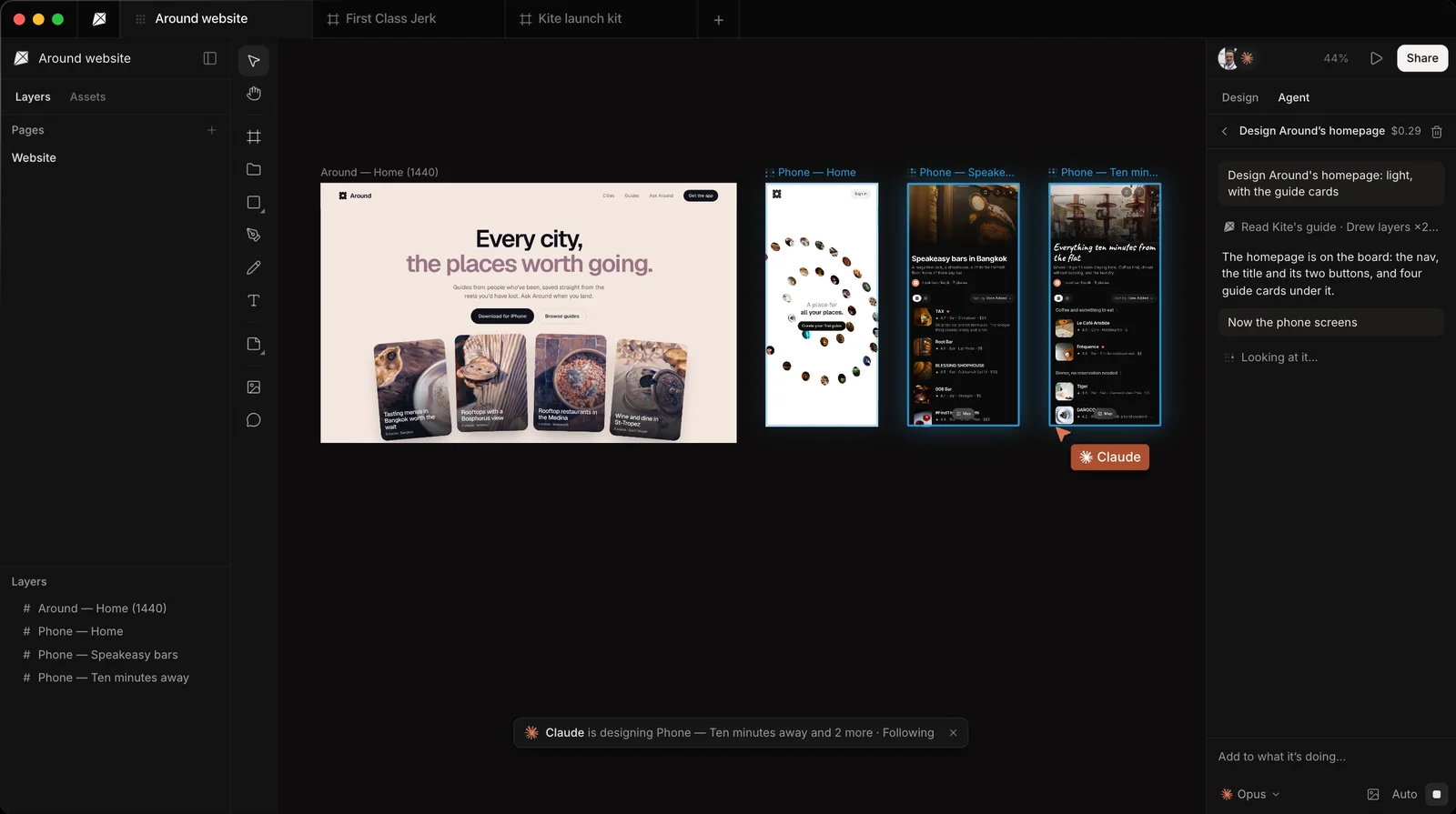
/design in Claude Code | Claude Code drawing in Kite | |
|---|---|---|
| What you get | Artboards in a Claude Design artifact | A design file of layers on a canvas of real HTML and CSS |
| Agents | Claude, in Claude's apps and Claude Code | Claude, ChatGPT, Cursor, Codex or any MCP client, several in one file |
| How it connects | An interactive Claude Code session signed in to claude.ai; off in -p, the Agent SDK and MCP-server contexts | An MCP server any agent connects to from anywhere, signing in with OAuth; built into Kite for Mac and Windows for agents on your machine |
| Design system | /design-sync for React systems, in beta on Pro and up | Components with variants, and variables with modes such as light and dark |
| Team review | Sharing and comments; multi-person editing “still basic” | Live cursors for everyone in the file, comment threads pinned to the design |
| Into code | Handoff to Claude Code | Copy any frame as HTML, React or Tailwind; export PNG, SVG or PDF |
| Price | Included in Claude plans with Claude Code: Pro is $20 a month, or $17 billed yearly | Free: unlimited editors, 3 files. Pro: $20 per editor a month. No AI credits: your agent runs on your own plan |
To try it from Claude Code:
- Run
claude mcp add --transport http kite https://kite.new/api/mcp. - Run
/mcp, choose kite and approve in the browser; there is no key to copy. - Ask: “Design a sign-up screen for our running club app in a new Kite file”, and Claude gives you the file's link, and you watch it draw.
Which to use: /design when you work alone in Claude Code and want a quick canvas to pick from before building. Kite when the design has to be shared and changed by a team, or when agents other than Claude work on it too. Other agents' steps are in Choose your client; for other tools, see Claude Design alternatives, and Pro is $20 per editor a month, or $16 billed yearly (pricing).
How we checked
Methodology, on November 20, 2026:
- We read Anthropic's product page and pricing page, and its help center on Claude Design, artifacts, design systems, the move, Claude Code on Pro and Max and the release notes.
- We read the Claude Code commands, artifacts, settings and overview docs, its changelog and week 34 notes, the Academy tutorial and the launch post.
- We ran Claude Code 2.1.327 headless three times in an empty folder:
/design, a plain request, and a check withenableArtifactset to true. Times are its own, and we did not run an interactive/designsession. - Kite facts come from Kite's own product and pricing pages; prices are in US dollars.
Questions
- Can you use Claude Design in Claude Code?
- Yes. Since Anthropic folded Claude Design into Claude, it works inside Claude Code, in the terminal and in the Claude desktop app. Run /design with a brief, or ask Claude to turn your idea into a design. Claude publishes a canvas of artboards as a Claude Design artifact and gives you the link; you edit it in a desktop browser. You need Claude Code v2.1.265 or later, a claude.ai sign-in, and a Pro, Max, Ultra, Team or Enterprise plan.
- How do I install Claude Design in Claude Code?
- There is nothing separate to install: /design and /design-sync are built into Claude Code. Update Claude Code to v2.1.265 or later, sign in with /login using a claude.ai account on a paid plan, and type /design followed by what you want drawn. On Team and Enterprise plans, an owner must leave the Design template on under Organization settings > Artifacts.
- Does /design work in the Claude Code CLI and terminal?
- Yes, in an interactive session, but not in a headless run. Anthropic's docs say artifacts are off by default when you run Claude Code with -p from your own terminal or scripts. They are also off in the Agent SDK, the GitHub Action and MCP-server contexts. In our -p run, /design only offered to manage access, and a plain request came back as text, with no canvas.
- What is the difference between Claude Design and Claude Code?
- Claude Design makes visual work: mockups, screen flows, prototypes and one-pagers on a canvas of artboards you can edit by hand. Claude Code is Anthropic's coding agent: it reads and changes your repository. Claude Design now runs inside Claude Code too, and a design hands off to Claude Code to be built. Claude Design is on every Claude plan, Free included; Claude Code starts at Pro.
- How do I hand off a Claude Design design to Claude Code?
- If you made it in Claude Code, stay in the same session and ask Claude to build it. To return later, open the design from Artifacts and use the button next to Share to reopen that session. If someone made it elsewhere, they give you edit access, and you paste the design's link into Claude Code inside your repository and ask Claude to implement it. The design's Export menu also has Handoff to Claude Code, with Send to local coding agent and Send to Claude Code Web.
- What does /design-sync do?
- It converts your repository's React design system and uploads it to Claude Design, so designs use your real components. You sign in with /design-login first, and a first sync can take a few hours on a large repo. Anthropic's command list says it uploads to the standalone claude.ai/design site, which closes by December 14, 2026, and it stops early if your design system has already moved to Claude.
- Is Claude Design the same as artifacts?
- Claude Design is one kind of artifact, and an artifact is anything Claude makes for you to put in front of someone, such as a design, a deck, a document or a dashboard. Claude Design is one of the templates you can start one from, and in Claude Code any page Claude publishes is an artifact; /design publishes one that opens in Claude Design's canvas editor.
- Is Claude Design in Claude Code free?
- Not on the Free plan, because Claude Code isn't on it: Anthropic's pricing table marks Claude Code "No" on Free, although Claude Design itself is on Free in a chat. In Claude Code you need Pro ($20 a month, or $17 a month billed yearly) or higher, and design work uses the same usage as the rest of Claude.