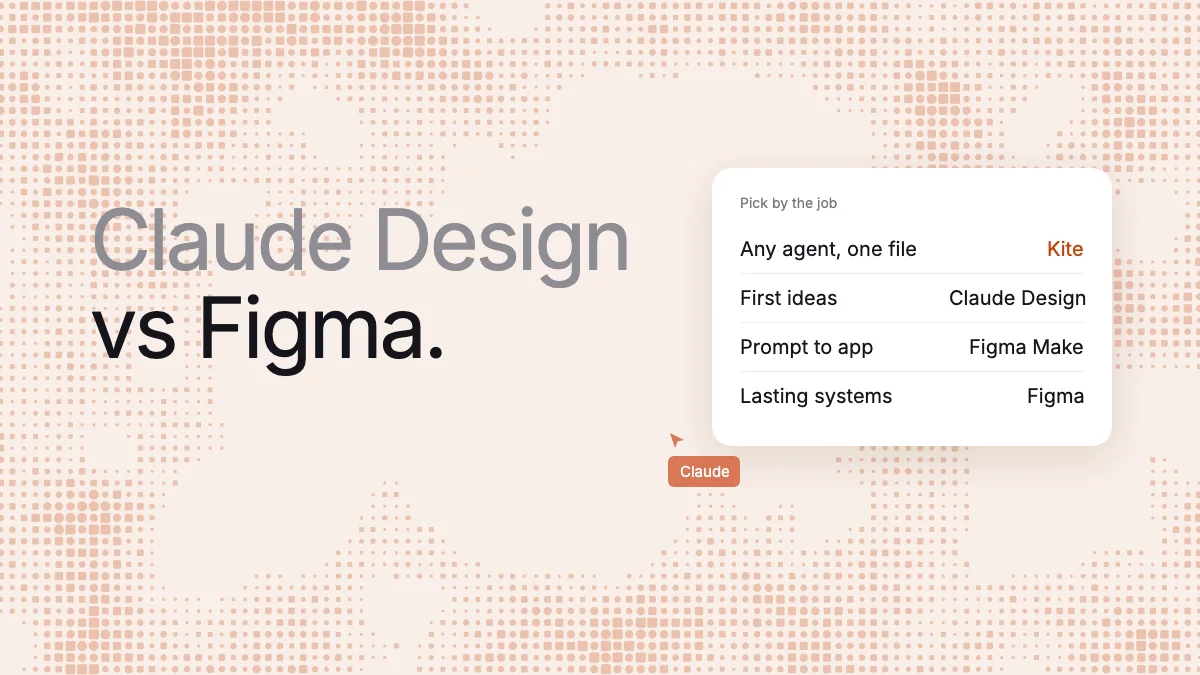
Short answer: Use Figma Make when the result has to be a working web app, published to a web address and built from your Figma libraries. Use Claude Design when you want a clickable flow, a one-pager or a landing page from a chat, on the Claude plan you already have, and then hand it to Claude Code. If your own agent should draw layers in a file your team keeps editing, there is a third option, Kite (kite.new), which we make.
Key takeaways
- Figma Make builds functional prototypes and web apps as code, with a backend, publishing, a model picker and version history. It runs on Figma AI credits.
- Claude Design makes designs, prototypes and one-pagers in any Claude chat, on every Claude plan, from your shared Claude usage. It has no version history yet.
- Make's preview copies into Figma Design as layers on paid plans; Anthropic lists no Figma export for Claude Design.
- On December 14, 2026 only claude.ai/design closes. Claude Design itself continues inside Claude.
Every Claude Design and Figma Make fact below was read on Anthropic's and Figma's own pages on November 20, 2026; Kite's come from our own product. Kite runs no model to design, and we say where it is the wrong pick.
Claude Design vs Figma Make: which to use for what
| You want | Use | Because |
|---|---|---|
| A working web app with logins and data | Figma Make | It scaffolds a backend and publishes to a web address |
| A prototype built from your Figma libraries | Figma Make | Make kits bring in library variables and styles |
| A clickable flow to react to, from a chat | Claude Design | It is in any Claude chat, with nothing to set up |
| A one-pager, PDF or PowerPoint | Claude Design | It exports PDF, PowerPoint and Google Slides |
| A design an engineer builds in Claude Code | Claude Design | Handoff to Claude Code is one of its exports |
| To go back to any earlier version | Figma Make | It keeps every AI and manual edit; Claude Design has no history yet |
| Claude, Codex or Cursor drawing in a file your team edits | Kite | Your own agent draws real layers, with no AI credits |
What each one is
Claude Design is Anthropic's design tool inside Claude. It “lets you create designs, interactive prototypes, one-pagers, and other visual work by chatting with Claude”, per its getting-started guide. It is a template you start an artifact from, in any chat, in Claude Code or in the Artifacts tab, and the Design template covers “mockups, prototypes, one-pagers, and landing pages”. A design is a canvas of artboards with layers you can drag, resize and align, and Anthropic pitches it for turning “a rough idea into a clickable flow your team can react to”.
Figma Make is, in Figma's words, “an AI-driven, prompt-to-app tool” that turns ideas and existing Figma designs into functional prototypes, web apps, and interactive UI. What it makes is code you can preview, publish, download or push to GitHub, and it lives in Figma beside your design files. Our Figma Make alternatives page covers it in more depth.
So the difference starts with what comes out. Claude Design makes a design you share or send on. Figma Make makes an app you can publish. Both start from a prompt.
Claude Design vs Figma Make, side by side
As of November 20, 2026, from each vendor's own pages, linked in the sections below. Kite, which publishes this page, is in the last column.
| Compare | Claude Design | Figma Make | Kite |
|---|---|---|---|
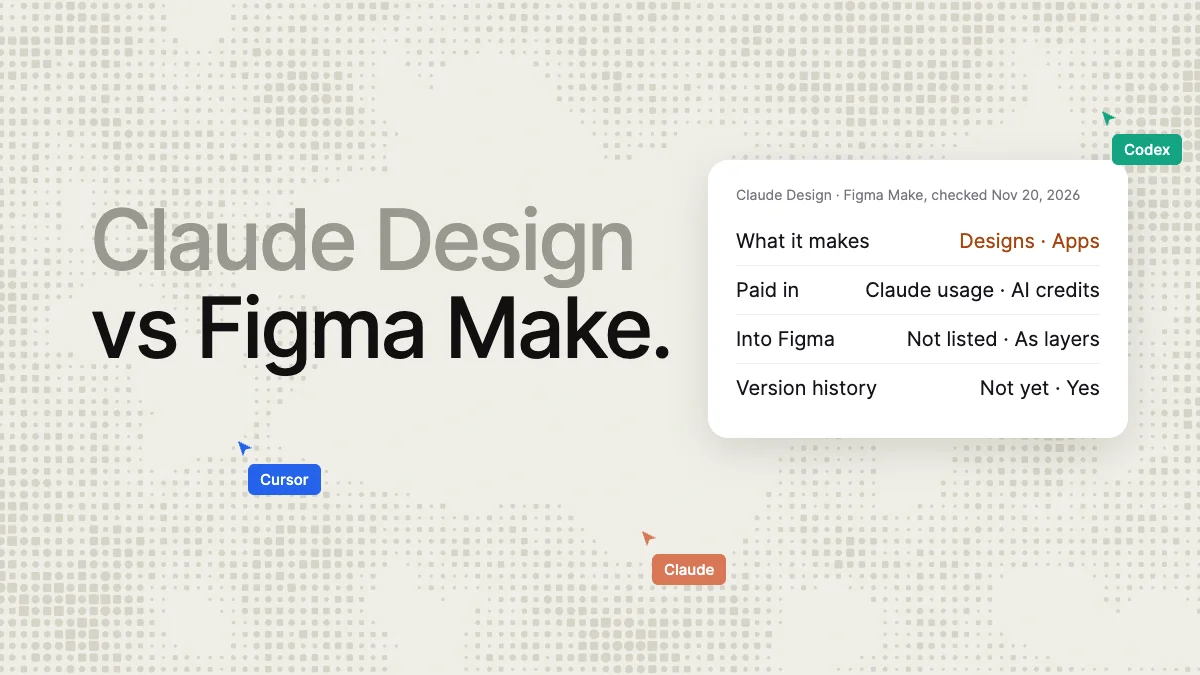
| What it makes | Designs, interactive prototypes, one-pagers, landing pages | Functional prototypes, web apps and interactive UI, as code | Design files of real HTML and CSS layers |
| Where it runs | Any Claude chat, Claude Code, the Artifacts tab, the iOS and Android apps | Inside Figma | In the cloud, in any browser or Kite for Mac and Windows |
| Model | Claude; Anthropic doesn't name the model | A default model, or GPT, Claude and Gemini models from a picker | None of its own: your agent does the designing |
| Price and plans | Every Claude plan; Pro $17 a month billed yearly, $20 monthly | Full seats on paid plans; Professional listed at $16 a month | Pro $20 an editor a month, $16 billed yearly |
| Free use | On Claude Free, without design systems or link sharing | Starter: 150 AI credits a day, up to 500 a month | Unlimited editors and viewers, 3 files, 100 agent actions a day |
| What use is counted in | Your Claude usage limits, shared with chats and Claude Code | AI credits per action; about 100+ to generate an app | No AI credits; your agent runs on the plan you already pay for |
| Design systems | Beta, Pro and up: from a repo, design files (Figma included) or uploads | Make kits: npm packages and published library styles; not on Starter | Design systems with variables and modes, like light and dark; 3 on Free |
| Exports | .zip, PDF, PowerPoint, Google Slides, standalone HTML, 15 tools, Claude Code | Publish to figma.site or your domain; code as .zip; push to GitHub | PNG, JPG, WebP, AVIF, SVG, PDF; copy as HTML, React or Tailwind |
| Into Figma | No export listed; Figma files only as an input | Preview copies into Figma Design as layers on paid plans, not synced back | Paste frames to and from Figma as editable layers |
| Agents and MCP | Claude only; no MCP server for other agents listed | Figma's MCP server can edit Make files; prompts to Make spend credits | Claude, ChatGPT, Cursor, Codex or any MCP client |
| Team editing | View, comment or edit; editing at once “still basic” | Multiplayer on Starter and Full-seat files; only Full seats share or publish | Live cursors and selections for everyone in the file |
| Version history | “doesn't have version history yet” | Every AI and manual edit, to preview or restore | On Pro: autosaves about every 10 minutes, plus named versions |
| On December 14, 2026 | claude.ai/design closes; Claude Design continues inside Claude | Nothing changes | Nothing changes |
What each one costs, and how use is counted
Claude Design comes with every Claude plan, Free included. Pro is $17 a month billed yearly, or $20 monthly, per Claude's pricing. It “counts toward the same usage limits as the rest of Claude”, Claude Code included, and Anthropic gives no number of designs per plan. When you reach the limit, Claude Design is unavailable until it resets, unless you have turned on usage credits.
Figma Make is included on the Full seat, listed at $16 a month on Professional with 3,000 AI credits; Organization is $55 and Enterprise $90, both billed annually, per Figma's pricing page. Dev, Collab and View seats can try Make in drafts but can't share or publish. Credits “don't roll over”, and Figma's own estimate for generating an app from scratch is about 100+ credits, though it says it “can't predict exactly how many credits it will use”. The free Starter plan gives 150 credits a day, up to 500 a month.
Put simply: if you pay for Claude and not for Figma, Claude Design costs you nothing more. If your team already has Full seats, Make is in the seat, and the credits are the limit. Both bills move with how much you iterate. Our Claude Design pricing and Figma pricing guides go plan by plan.
For example, take a five-screen sign-up flow your team wants to click through and then ship. In Make, Figma's own estimate is about 100+ credits to generate an app from scratch, out of 3,000 a month on a Professional Full seat, and the result publishes to a figma.site address. In Claude Design, the same request comes out of your Claude usage, with no number to plan by, and goes on to Claude Code or v0 to be built. This example comes from each vendor's documentation; we didn't run it in either tool.
Your design system in each
Claude Design reads a design system “from a GitHub repo, design files, raw uploads, or your local codebase”. Its design system guide lists Figma files among the sources, and React component libraries come in through /design-sync in Claude Code. Design systems are in beta on Pro and up, and admins can lock a team to one approved system.
Figma Make uses Make kits, which can hold “npm packages for code context”, “variables and styles from published Figma Design libraries” and guidelines. Kits are on paid plans; Starter “cannot use team libraries to bring style context to Figma Make”.
If your system lives in Figma libraries, Make reads it where it already is. If it lives in a React repository and your team uses Claude Code, Claude Design is the shorter route.
What you get at the end
- From Claude Design: a .zip, a PDF, PowerPoint, Google Slides or standalone HTML; a send to 15 tools, among them Canva, Lovable, Miro, Replit, v0 and Vercel; or a handoff to Claude Code. Sharing by link starts on Pro, per Anthropic's sharing guide.
- From Figma Make: a published app at a figma.site address or up to 10 custom domains on Professional; code you download as a .zip with a Full or Dev seat; or a one-way push to GitHub. Make now scaffolds a Payload backend with “a database, APIs, auth, and an admin panel”, though Figma says GitHub isn't yet available for Payload-backed apps.
- Into Figma: on paid plans, a Make preview copies into Figma Design as layers, but changes “aren't applied back” and the layers “aren't automatically tied to your design system”. No Anthropic page lists Figma as a Claude Design export; see how to get a Claude Design into Figma.
- History: Make keeps every AI and manual edit to preview or restore. Claude Design “doesn't have version history yet”; you can ask Claude to save the project before trying a new direction.
Can other agents use them?
Claude Design works only with Claude. Anthropic documents no MCP server, connector or API that Cursor, ChatGPT or Codex could call; inside Claude Code it is the /design command. More in Claude Design MCP.
Figma's MCP server lets agents “make edits to Design, FigJam, Slides, and Make files”. Prompts sent to Make that way spend AI credits rather than counting toward MCP rate limits. Make also runs several outside models itself: its model picker lists GPT-5.6 Terra, GPT-6.1 Sol, Claude Sonnet 4.5, Claude Opus 5.5, Gemini 3.8 Flash and Gemini 4 Argon beside the default (Figma's plan-mode page still names Claude Opus 4.7). So Make can run on Claude, paid in Figma credits, while Claude Design runs only inside Claude.
What December 14 changes for this choice
Anthropic's moving guide says the standalone site, claude.ai/design, closes on December 14, 2026, and tells you to move or download your projects before then. Anything left there is deleted some time later, and chats and comments don't move to Claude. Claude Design itself keeps working in every Claude chat.
So December 14 isn't a reason to switch to Make. It is a deadline to move or download old projects; downloading a project archive is free and doesn't count toward your limits. Switch only if you need what Make has: publishing, a backend, version history or your Figma libraries. Our is Claude Design shutting down? guide has the checklist, and Claude Design alternatives covers other tools.
Where Kite fits
Kite (kite.new) is a third option for one job: your own agent, such as Claude, ChatGPT, Cursor or Codex, drawing real HTML and CSS layers in a shared file that your team edits and comments on. It connects over MCP (Model Context Protocol), the open standard agents use to work in other tools. Kite runs no model to design, so there are no AI credits: the agent runs on the plan you already pay for.
- Figma both ways: frames paste to and from Figma as editable layers, with Copy to Figma.
- Comments as jobs: @-mention an agent in a comment; in Kite for Mac and Windows it can start at once.
- Free to start: unlimited editors and viewers, 3 files and 100 agent actions a day.
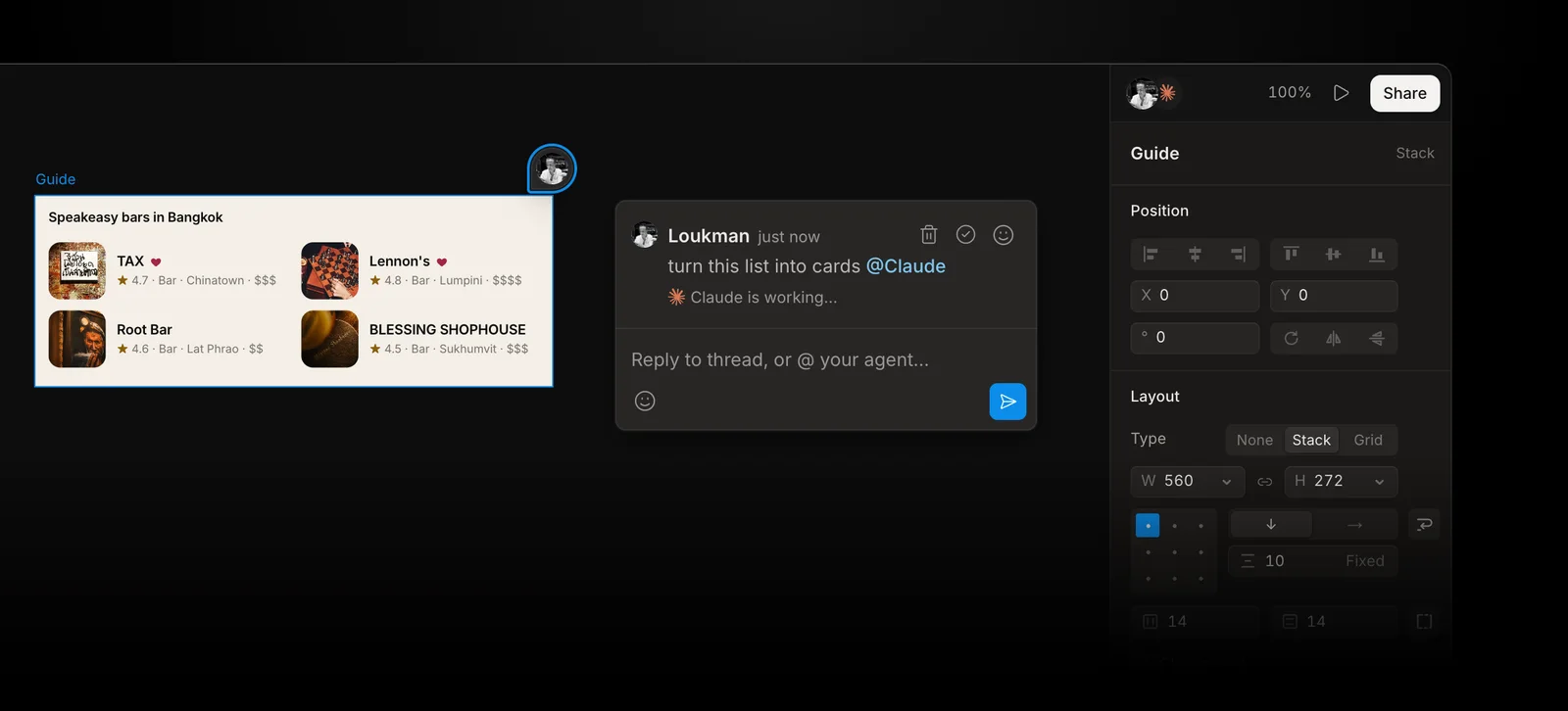
Where Kite is the wrong pick: it doesn't build or publish apps, and it has no clickable prototype flows. For those, use Make or Claude Design. To start with your own agent, see how to design with your agents.
How we checked
Methodology: on November 20, 2026, we read Anthropic's getting-started guide, product page, pricing, sharing guide, design system guide and moving guide. On Figma's side we read its pricing page, Make page, Make FAQ, AI credits page, model picker, Make kits, publishing, code, GitHub and backend help pages, and its MCP rate limits, all linked where used. Figma's model page lists Claude Opus 5.5 while its plan-mode page names Claude Opus 4.7, so we name the model picker's list. We didn't run Claude Design and Figma Make side by side. Figma's pricing page prints $16 without saying whether it is billed monthly or yearly, so we write “listed at”. Where a vendor doesn't say something, we say so rather than guess. Every source is linked where it is used, and we check this page again every quarter.
For the two tools beside Figma itself, see Claude Design vs Figma; for Google's generator, see Claude Design vs Google Stitch.
Questions
- Is Figma Make better than Claude Design?
- For a working web app it is: Figma Make publishes to a web address, can add a backend with a database and logins, and keeps a version of every AI and manual edit. For a clickable flow, a one-pager or a deck-style export from a chat, Claude Design is closer, and it comes with every Claude plan. Neither is better at everything.
- Is Figma Make free?
- You can try it on Figma's free Starter plan, with 150 AI credits a day, up to 500 a month. Starter can't use team libraries in Make, and publishes to the public web only through the Figma Community. Make is included on Full seats on paid plans, listed at $16 a month on Professional with 3,000 credits.
- Is Claude Design free?
- Yes. Claude Design is on every Claude plan, Free included, and draws from the same usage limits as your chats and Claude Code. On Free there are no design systems and no sharing by link. Claude Pro is $17 a month billed yearly, or $20 monthly.
- Can Figma Make use Claude?
- Yes. Besides its default model, which Figma doesn't name, Make's model picker lists Claude Sonnet 4.5 and Claude Opus 5.5, as well as GPT and Gemini models. That is Claude inside Figma, paid in Figma AI credits; it is not Claude Design.
- Can Claude Design export to Figma?
- No Anthropic page lists a Figma export. Claude Design takes Figma files in, as a source for a design system, and exports a .zip, PDF, PowerPoint, Google Slides or standalone HTML, or sends work to 15 tools such as Canva, Lovable and v0. A Figma Make preview, on paid plans, copies into Figma Design as layers.
- Can I move a Claude Design project into Figma Make?
- Neither Anthropic nor Figma lists a way to move one into the other. Claude Design can export standalone HTML or a PDF to keep as a reference, and Make starts from a prompt or from existing Figma designs.
- What happens to Claude Design on December 14, 2026?
- Only its standalone site, claude.ai/design, closes. Claude Design keeps working inside Claude. Move or download old projects before then: Anthropic says what is left there is deleted some time after the close, and chats and comments don't move. Figma Make isn't affected.